Isn’t it strange how communicating a topic in short, simple terms is more difficult than explaining it using advanced terms without a word limit?
Think about an advertisement. The best advertisements explain their main point in a simple and engaging way. They don’t lecture you; they work to hold your interest long enough to share their message.
What if we approached science writing and communication in a similar way?
Effective science writing and communication combines the art of communication with the impact of science.
It relies on having a deep understanding of their audience and their communication preferences, conscious or unconscious. It taps into emotion, instead of shunning it. It revels in remaining as simple as possible. Why be more complicated than necessary?
I like seeing how far concepts can be broken down. Can it be made easier to understand? More entertaining to learn about? How many more people will be interested enough to learn more?
Explaining concepts conversationally instead of academically is vastly underrated.
An Example:
Below, I took the concept of Antibiotic Resistance and explained it using my Invite, Inform, Inspire tips and tricks and a reading level of 9th grade or lower. See how it compares to this excerpt from the CDC’s page on antibiotic resistance, which uses a 12th grade reading level:
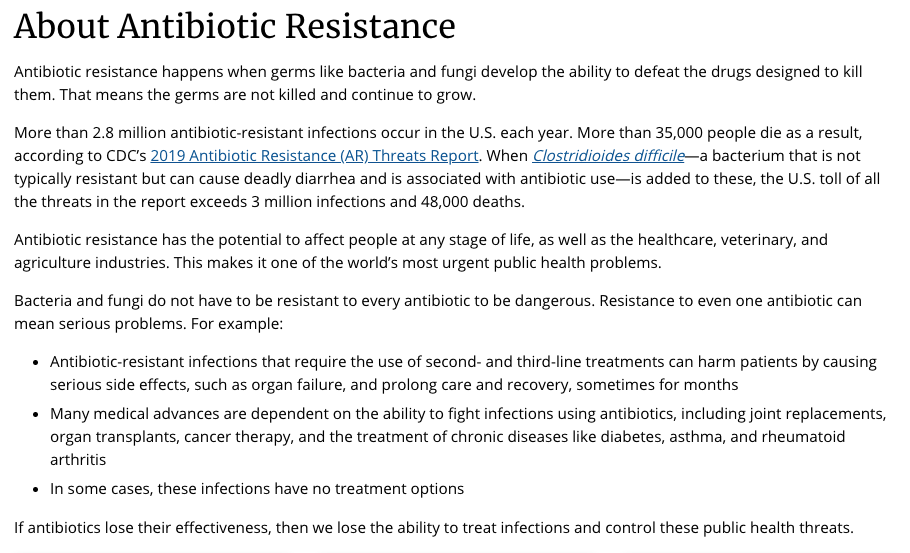
VS.
What is a skill you’re proud of? If you hadn’t practiced that skill, would you be just as good? Probably not.
Did you know that bacteria that make us sick also practice?
Bad bacteria get stronger each time they practice fighting against anti-bacteria medicine, also called antibiotics. Taking antibiotics when you don’t need them actually helps bad bacteria get strong enough to fight off the medicine.

If the bacteria get skilled enough at beating antibiotics, it’s called antibiotic resistance. Antibiotic resistance is bad news for any human capable of getting sick from bacteria (AKA, everyone).
Because if you got really sick, wouldn’t you want your medicine to work?
But thankfully, everyone can help in the fight against antibiotic resistance!
We can outsmart these bacteria together by only taking antibiotics if a medical professional prescribes them to us. This way, the bacteria don’t get enough practice. (Medical professionals are trained to identify what illnesses are caused by bacteria and will get better from antibiotics vs. other treatments.)
Not everyone has heard about these belligerent bacteria and their constant quest to one-up the human race. Talk to your family and friends to see if they know this simple way to join in the fight against antibiotic resistance. For more information, go to: https://www.cdc.gov/drugresistance/index.html.
Which messaging would an average joe be more likely to read all the way?
Of course, there is a time and place for highly scientific/academic writing. But too often I see science professionals communicating with an audience who aren’t interested in being communicated with like academics.
Most of us just want to be spoken to like humans who have options about where to spend our precious attention.
So let’s strive to make content informative, accurate, and interesting. Tell me your science communication techniques in the comments.
 Sci Com Blog